Looking for SEO Services?
Our SEO experts will boost your rankings, drive traffic, and increase conversions.
Get Found. Get Leads. Get Sales.
Book a ConsultationContents
- Introduction to Lead Generation in Modern Digital Marketing
- How SEO Drives High Intent Traffic
- Role of Social Media Advertising in Lead Acquisition
- Why Traffic Alone Does Not Convert into Leads
- Direct Messaging as a Conversion Layer
- Complete Lead Flow From Search to Conversation
- Agency Execution Model for Lead Generation
- Tools and Systems Used in Lead Generation
- Industry Use Cases
- Challenges in Multi Channel Lead Generation
- Future Direction of Lead Generation Systems
- Frequently asked questions
Introduction to Lead Generation in Modern Digital Marketing
You may already be getting traffic on your website, and sometimes the numbers look strong when you open analytics, but when you actually check how many people contact you or become customers, the gap becomes very clear. This is where most businesses start questioning what is missing.
In many cases, SEO brings visitors who are already searching for something specific, while social media advertising pushes your offer in front of people who may not be actively searching but still show interest based on targeting. These two channels work differently, yet many businesses still run them separately without connecting the final step.
The problem starts when traffic comes but no real interaction happens. A visitor reads your page, scrolls a bit, and then leaves without taking any action. This is not because the traffic is wrong. The missing part is the conversion layer that turns visits into conversations.
How SEO Drives High Intent Traffic
Organic Search and User Intent
When someone types a query into a search engine, that action itself shows intent. You are not guessing here. The user is already looking for something, and that is why SEO keeps working as a steady traffic source over time.
You might notice that some users search with clear buying intent, while others are still exploring. A person searching for a service near them is already closer to action compared to someone just trying to understand the topic.
This is where keyword targeting plays a role. You are not just writing content. You are aligning your pages with real searches. Over time, this creates a consistent flow of visitors who are more likely to take action compared to random traffic.
On Page Technical and Local SEO
Once traffic starts coming, the structure of your website starts affecting user behaviour. If your content is hard to read or your page loads slowly, users leave quickly even if they are interested.
Technical SEO decides how search engines read your website. Indexing, crawl access, and internal linking directly affect how your pages appear in results.
Local SEO becomes important when your business depends on location based searches. If someone searches for a service in a specific city, your visibility depends on how well your business is optimized for that location.
Limitation of SEO Alone
Even when everything is done correctly, SEO still has one limitation. It brings users to your page, but it does not push them to take action.
Many businesses face this situation where they rank well but still do not get enough leads. Users read the content but leave without contacting.
At this stage, agencies expand their execution model. This is where services like white label SEO are used to scale delivery while maintaining output for multiple clients.
Role of Social Media Advertising in Lead Acquisition
Paid Advertising Platforms
Social media advertising works differently compared to SEO. You are not waiting for users to search. You are placing your offer directly in front of them based on interests and behaviour.
Platforms like Facebook, Instagram, and LinkedIn allow businesses to define who sees their ads. This creates a faster flow of traffic compared to SEO.
Ads start working as soon as campaigns go live, which makes them useful when immediate visibility is required.
Ad Creatives and Funnel Entry Points
You might have noticed that some ads perform better even when targeting is similar. This depends on how the message is presented.
When users click on an ad, they expect the landing page to match what they saw. If that connection breaks, users leave quickly.
A campaign works better when the ad, landing page, and next step all feel connected.
Tools Used in Social Media Campaigns
Running ads without proper systems becomes difficult as campaigns grow. You need tools that track performance and help adjust campaigns based on data.
Two main functions appear in most setups:
- Campaign tracking where impressions, clicks, and conversions are monitored and adjusted.
- Audience analysis where behaviour data is used to improve targeting.
A social media management tool helps manage campaigns, track results, and adjust targeting. Without this, ads become guesswork.
Why Traffic Alone Does Not Convert into Leads
You may have already seen this pattern. Traffic increases but leads do not increase at the same rate.
Two common reasons appear:
- Users visit the page but leave because there is no quick way to connect.
- Users feel interested but delay action because forms take time.
One issue is the lack of instant interaction. Users land on your page but do not find a quick way to talk to you.
Another issue is hesitation. Users need clarity before making a decision, and if that moment passes, they leave.
This is where direct messaging becomes important.
Direct Messaging as a Conversion Layer
You may have noticed that when users get a quick reply, they stay longer in the interaction. This is where messaging changes the conversion process.
Instead of waiting for forms or emails, businesses now give users a direct way to start a conversation.
Shift from Forms to Conversations
Traditional forms still exist, but many users avoid filling them unless necessary. They take time and effort.
Two clear differences appear with messaging:
- Users can ask questions instantly.
- Businesses can respond in real time.
This reduces delay and increases conversion chances.
WhatsApp as a Lead Conversion Channel
WhatsApp is already used daily by most users, which makes it easier for businesses to start conversations.
Click to chat behaviour allows users to move directly from a page or ad into a conversation without extra steps.
Businesses use tools to generate online WhatsApp short links so users can start chatting without saving numbers. This reduces friction and increases engagement.
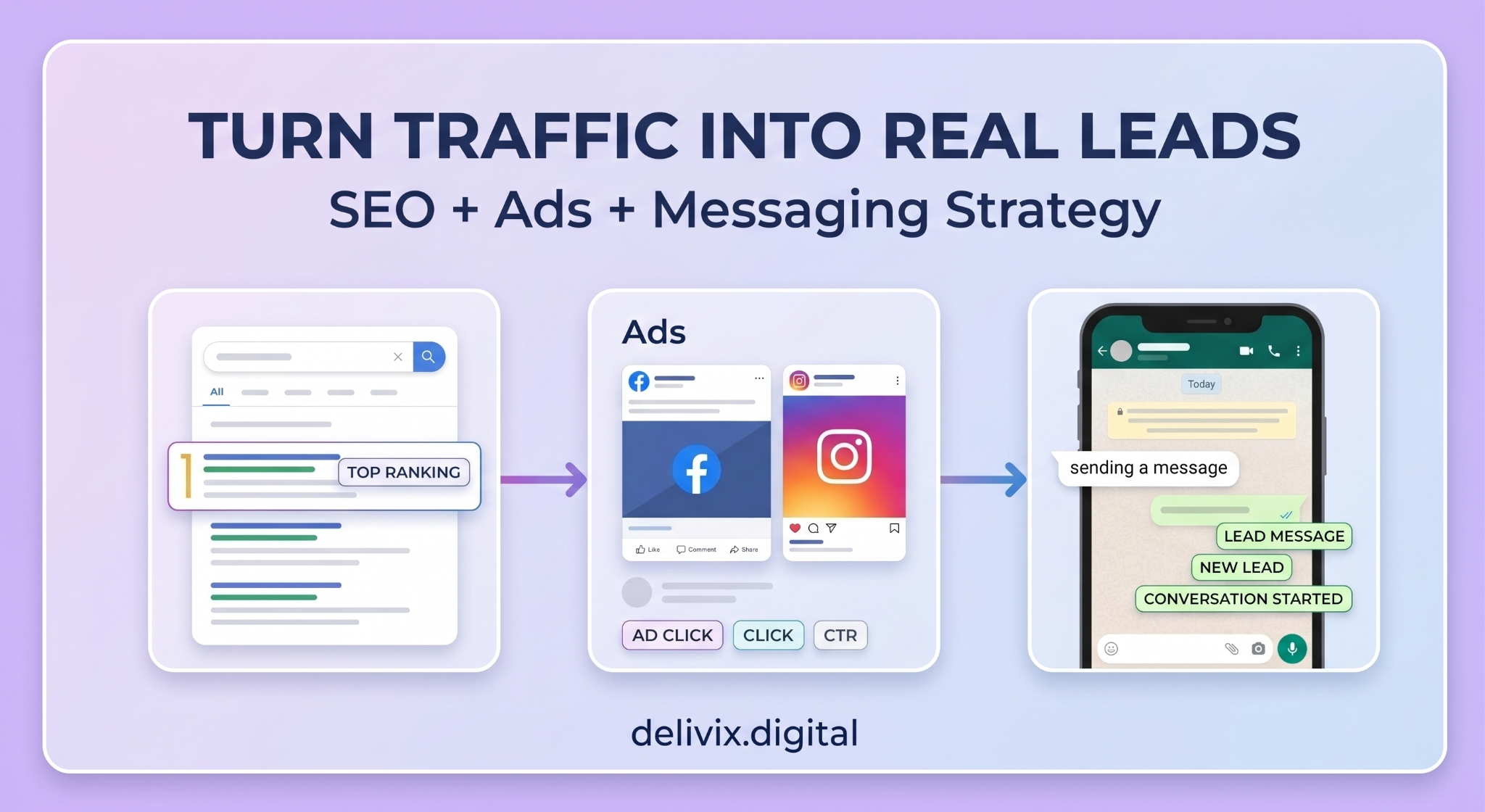
Complete Lead Flow From Search to Conversation
When all layers connect, the journey becomes clear.
- A user finds your page through SEO.
- The same user may see your ad later.
- The user lands on your page.
- The user starts a conversation.
This flow connects traffic with real interaction.
Agency Execution Model for Lead Generation
Combining SEO and Paid Ads
Agencies combine SEO and ads instead of depending on one channel.
SEO builds steady traffic, while ads bring faster results.
Scaling Campaigns Using White Label Services
As agencies grow, managing multiple clients becomes difficult. White label SEO allows agencies to deliver services under their own brand while outsourcing execution.
Tools and Systems Used in Lead Generation
Businesses use multiple systems together.
- SEO tools track traffic and rankings.
- Advertising and messaging tools manage campaigns and conversations.
These systems work together to create a connected flow.
Industry Use Cases
Different industries apply this model differently.
- Local businesses use SEO and messaging for quick inquiries.
- E-commerce brands use ads and messaging for product queries.
Challenges in Multi Channel Lead Generation
Even with setup, some issues appear.
- Tracking lead sources becomes difficult.
- Delayed responses reduce conversions.
Future Direction of Lead Generation Systems
Businesses continue to connect SEO, ads, and messaging.Automation and AI tools are used to manage campaigns and responses.
Frequently asked questions
The most common questions we get asked.