Contents
- Content
- Why Digital Agencies Need AI SEO Workflows
- What an AI SEO Workflow Actually Means
- A Practical AI SEO Workflow for Agency Teams
- Key Benefits for Agency SEO Workflows
- Using AI for Content Planning and Content Refreshes
- Using AI for On Page SEO and Technical Checks
- AI and the Reporting or Feedback Workflow Loop
- Where AI Fits in the Agency Team
- Common AI SEO Mistakes Agencies Should Avoid
- The Value of AI SEO for Agencies
- Frequently asked questions
- Conclusion
Content
Digital agencies are now working in a very different SEO environment. Clients want faster research, faster content planning, faster reporting, and better results from the same team size. At the same time, search results are changing because AI answers, Google updates, and stronger competitors are putting more pressure on normal SEO work.
AI can help an agency move faster, but it cannot fix a weak SEO process on its own. A random prompt here and a quick draft there will not create a strong workflow. The agency needs a clear system where AI helps with research, planning, review, reporting, and decision support, while the final control still stays with trained people.
This is where AI SEO workflows become useful for digital agencies. A workflow gives your team a repeatable way to use AI without losing quality. It also helps your writers, editors, SEO specialists, and account managers work from the same process instead of using different tools in different ways.
Why Digital Agencies Need AI SEO Workflows
Artificial intelligence continues to dominate the headlines around applications within every digital market, with agencies under pressure to find high-quality AI workflows to speed up their processes.
Regardless of a company’s love/hate or tolerance for AI, smart AI application features are a key feature of most SEO software. And workers continue to test general and market-specific AIs to gain a competitive advantage or make up for lack of knowledge and staff in key areas. Whatever the approach, build an AI playbook that everyone must follow before the output is used for client work.
A strong AI playbook should explain what your team can use AI for and what must be checked manually before anything goes live. AI can support keyword research, topic clustering, SERP comparison, content brief creation, outline review, metadata ideas, internal link suggestions, and report summaries. A human should still check search intent, factual accuracy, brand voice, client positioning, legal claims, and final publishing quality.
SEO specialists use AI to grow their own skills to maintain their role, and deliver AI results before it comes mandated, as many fear AI will take their jobs. While business leaders look for the maximum operational efficiency across their agency. And with headlines like “Why 80% of UK Marketing Agencies Will Be Dead or Acquired by 2028,” the sense of urgency for an AI-focus continues to grow.
The real pressure is not only about saving time. Agencies also need to produce better decisions from large amounts of data. A team may have keyword exports, competitor pages, old content, ranking reports, client goals, and technical audit data sitting in different places. AI becomes more useful when it helps organise that information into something the team can review and act on.
What an AI SEO Workflow Actually Means
An AI SEO workflow is a repeatable process where AI supports a defined SEO task. It is not the same as asking AI to write a full article and publishing it without review. It is more like giving AI a controlled job inside the SEO process and then checking the result before moving to the next stage.
For example, your agency can use AI to group 500 keywords by search intent. The SEO specialist can then review those groups, remove wrong matches, and decide which clusters deserve a landing page, a blog post, or a content refresh. The AI speeds up the sorting work, but the SEO specialist still makes the final decision.
The same idea applies to content briefs. AI can compare competitor headings, identify missing subtopics, and suggest questions to answer. The editor can then refine the brief based on the client’s actual product, target audience, and brand tone.
A Practical AI SEO Workflow for Agency Teams
Creating a workflow with any AI can be done in a set of repeatable steps. Typically, feed the AI with your target keywords and a competitor list, where available. Use prompts to highlight your intentions, primary and secondary terms, and add a unique or human angle that will make draft articles engaging and accessible. One great addition is asking the AI to add “real-world examples,” which provide links to positive stories around the subject matter.
A better agency workflow usually starts before the writing stage. The team first collects the client goal, target audience, current rankings, competitor URLs, important service pages, and any previous content that should be updated or internally linked. AI works much better when it receives this background because it can connect the SEO task with the real client situation.
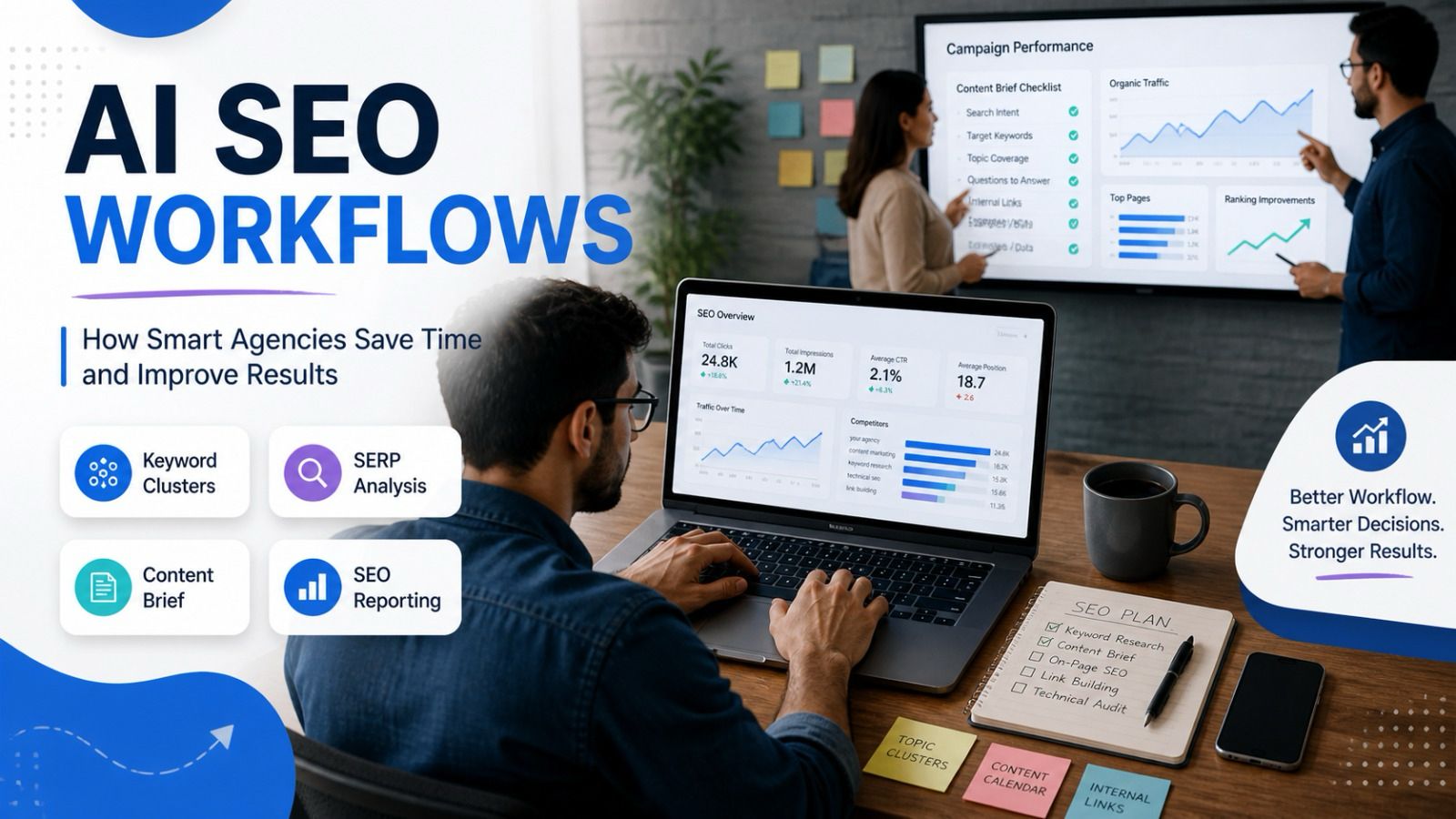
Here is a practical workflow your AI agency can use.
| Workflow stage | What AI can do | What your team must check |
|---|---|---|
| Keyword research | Group keywords by topic and intent | Search volume, ranking difficulty, business value |
| SERP review | Compare ranking pages and common headings | Real search intent and competitor quality |
| Content brief | Suggest an outline, questions, and missing topics | Brand fit, expert angle, internal link plan |
| Draft review | Find weak sections and repeated points | Accuracy, tone, examples, usefulness |
| Reporting | Turn raw data into client-ready notes | Cause of change, next action, priority |
This type of workflow keeps AI inside a controlled system. The agency does not depend on AI to think for the team. The agency uses AI to reduce slow work around research, sorting, comparison, and first-level review.
Key Benefits for Agency SEO Workflows
Whatever the AI, and the specific function, from SEO, GEO (Generative Engine Optimisation) across B2B or B2C markets, AI comes with some clear benefits.
For any size of agency, it can speed up tasks like keyword research, clustering and list processing to save time, and create more accurate targeting, helping create clearer, faster strategies. If your company is keeping AI at arm’s length, then using an expert AI SEO agency is one way to test the technology without committing.
The biggest benefit is not only speed. AI can help a team remove repeated manual work that usually eats up hours. Keyword grouping, title comparison, content gap checks, metadata drafting, and report writing can take a lot of time when done from scratch every time.
AI also helps agencies make their process more stable. If every writer creates briefs in a different way, the content quality will keep changing from one client to another. When your team uses the same AI prompt structure and the same review checklist, the output becomes easier to manage.
Based on those keywords and topics, AI creates content briefs, rooted firmly in the data. Those briefs can be delivered for further discussion, or the AI can create a draft output for editors to clean up.
A good AI content brief should not only list headings. It should explain what the searcher wants to solve, what the article must cover, where examples are needed, and how the article should connect with the client’s product or service. This helps the writer understand the task before starting the draft.
The brief still needs a human check. AI can miss the real reason a page is ranking. It can also suggest sections that look useful but do not match the client’s offer. The SEO lead should check the SERP before the brief goes to the writer.
Using AI for Content Planning and Content Refreshes
Content planning becomes easier when AI is used with the right input. A digital agency can upload or paste a list of existing URLs, target keywords, ranking positions, and traffic changes. AI can then help identify which pages may need updates, which topics are missing, and which pages can support each other through internal links.
For content refresh work, AI can compare an old article with the current ranking pages. It can show missing questions, weak sections, outdated examples, and areas where the article does not fully answer the search intent. The editor can then decide what needs rewriting and what should stay as it is.
This is useful because many agencies already have clients with large blogs. A client may not need 50 new articles every month. In many cases, the better move is to improve existing pages that already have impressions or rankings but are not getting enough clicks.
Using AI for On Page SEO and Technical Checks
Where AI can deliver another benefit is by taking the final draft and improving on-page optimisation, performing technical SEO.
AI can review page titles, meta descriptions, headings, schema markup, internal link suggestions, and content structure. It can also help find repeated titles, missing descriptions, weak heading order, and pages that do not have enough contextual internal links.
For technical SEO, the agency can use crawler exports from tools like Screaming Frog, Sitebulb, Ahrefs, Semrush, or other SEO platforms. AI can help read those exports and find patterns in missing tags, duplicate pages, redirect chains, broken links, thin content groups, and indexing issues.
The final technical decision should not be left to AI. A developer or SEO lead still needs to check CMS limits, plugin conflicts, server rules, client priorities, and the risk of changing live pages. AI can help notice the pattern, but your team still owns the fix.
AI and the Reporting or Feedback Workflow Loop
During or after a campaign, AI can analyse your SEO results and deliver the statistical highlights to team and business leaders. It can also look deeper into the numbers to make suggestions for future campaigns or to improve the performance of existing examples.
Alongside those ideas, it can also provide predictive SEO forecasting through pattern detection and KPI analysis.
A reporting workflow becomes stronger when AI receives both numbers and context. A traffic drop can happen because of seasonality, a lost keyword position, a technical change, a Google update, a weaker click-through rate, or stronger competitor pages. AI can list possible reasons, but the SEO team must verify the real cause before sharing it with the client.
Client reporting should avoid vague AI language. A good report should say what changed, where it changed, what the team checked, and what the recommended next step is. This keeps the report useful for the client instead of turning it into a long automated explanation.
Where AI Fits in the Agency Team
AI works best when each team member uses it for a clear purpose. An SEO strategist can use AI for keyword grouping, SERP comparison, and brief planning. A content editor can use it to check missing sections, repeated wording, weak explanations, and tone gaps.
An account manager can use AI to turn campaign updates into client-friendly notes. A technical SEO specialist can use AI to review crawl exports and find patterns that need deeper checking. The tool supports the work, but the role does not disappear.
This matters because agency teams often become messy when everyone uses AI in a different way. One person may use it for full drafts. Another person may only use it for headlines. Another person may rely on it for technical answers. A shared workflow makes the output easier to review and safer to send to clients.
Common AI SEO Mistakes Agencies Should Avoid
Many agencies get poor results from AI because they treat it like a full replacement for SEO thinking. They ask for a complete article, publish the output quickly, and expect rankings to improve. That approach usually creates thin content, repeated advice, weak examples, and pages that do not match the client’s real market.
Another mistake is using AI without a review checklist. Every AI assisted page should be checked for search intent, factual accuracy, internal links, external source quality, brand tone, and usefulness for the target reader. The review stage is where the agency protects the client from low quality output.
Some teams also make the mistake of feeding AI very poor input. If the prompt only says “write an article on SEO workflows,” the output will usually sound generic. If the prompt includes client details, target audience, competitor URLs, internal pages, keyword intent, and content goal, the output becomes much easier to shape into useful content.
The Value of AI SEO for Agencies
Whether your business is toying with free AI tools, testing the features in your SEO app or racking up the token bill for endless bespoke prompts, there is great and proven value from AI. The AI helps develop repeatable tasks and measurable results, compared to a more organic approach.
Using AI helps focus on accelerating performance, but only where it adds value. And helps review results to provide options on where to focus next, providing details competitor analysis, SERP insights and focusing on authority over the typical numbers game.
However, AI is far from a silver bullet to help poorly performing campaigns of agencies focused on their traditional approach. Where many SEO operators go wrong is by thinking AI can deliver a high-volume approach to SEO and articles, resulting in a swamp of content that no one will ever see.
This is why AI should support the agency process instead of replacing it. A good workflow gives the team better starting points, faster comparisons, and cleaner review notes. The final article, campaign plan, or report still needs human judgment because clients are not paying only for output. They are paying for decisions that connect with business goals.
Whatever approach you take, a thorough check for brand consistency, factual statements, tone of voice and mix of internal and external links is key to ensuring any article has merit. Similarly, creating Instagram or LinkedIn posts will require a different set of goals and starting data to ensure a useful end result.
A useful AI review checklist can include search intent, factual accuracy, brand fit, internal links, external sources, and final readability. The team should check if the content answers the actual query, if the examples make sense, and if the page connects naturally with the client’s service.
Frequently asked questions
The most common questions we get asked.
Conclusion
AI SEO workflows are useful when an agency treats them like a process, not a replacement for strategy. The best results come from clear input, fixed review steps, and human approval before publishing. AI can speed up keyword research, content briefs, content review, technical checks, and reporting, but the agency still needs SEO judgment at every stage.
A digital agency should start with workflows that are easy to control. Keyword clustering, content brief creation, content refresh checks, and report summary preparation are good starting points. Once the team understands what works, the workflow can expand into deeper technical checks, competitor research, content planning, and client reporting.